
01
Collect solar heat
The concrete absorbs energy from the sun. The patented approach includes surface treatments that increase heat absorption.
SOLAR THERMAL TECHNOLOGY FOR AIRPORTS
Solar energy is already reaching your apron.
Let’s put it to work.
A patented approach to recovering heat from concrete airport surfaces — connecting infrastructure with a new purpose.
Explore the technology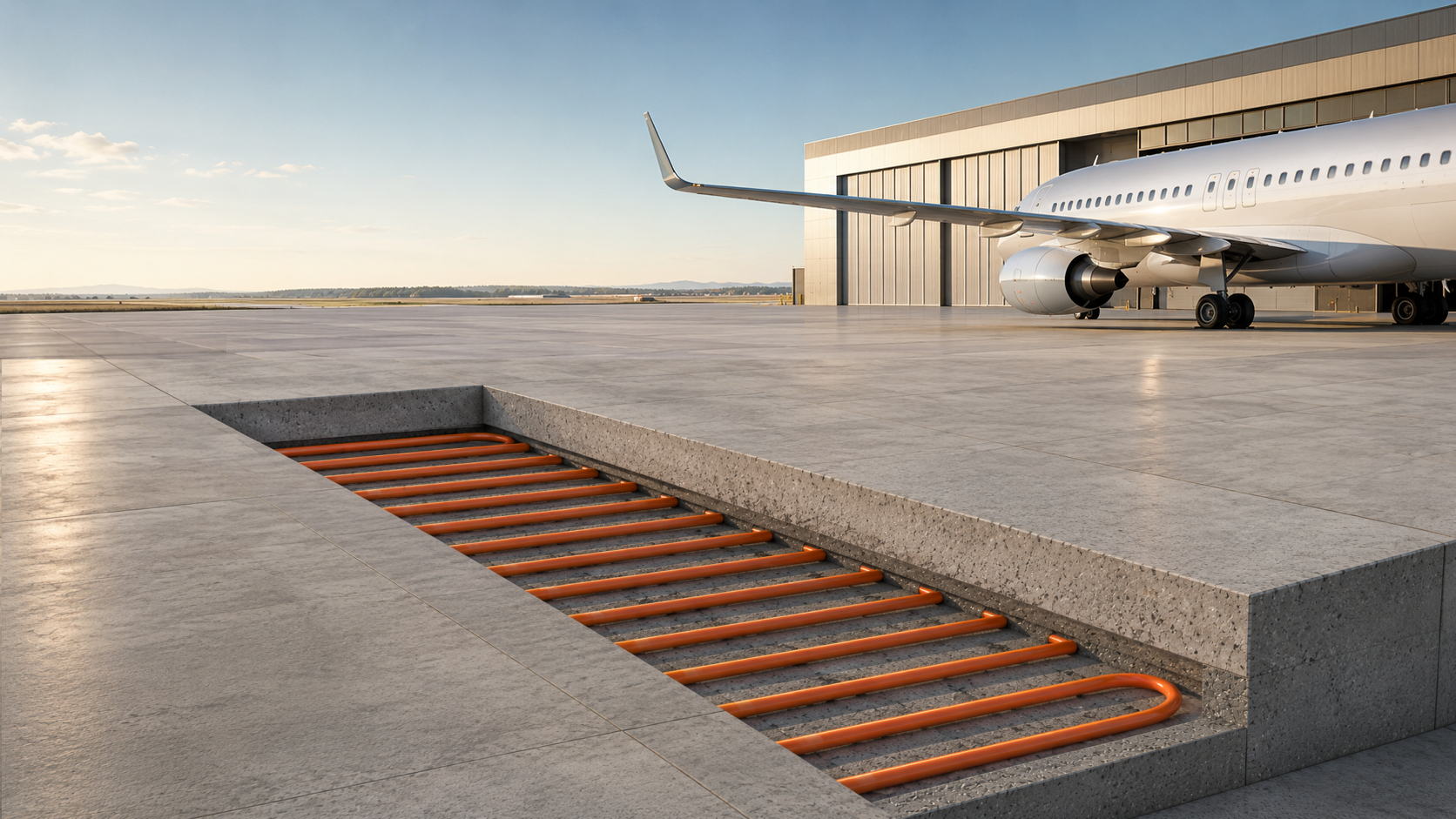
01 / THE TECHNOLOGY
Sunlight heats the concrete surfaces of an airport apron. Solar Apron is developing a way to recover this thermal energy through embedded pipework and connect it to local heating demand.
The concrete absorbs energy from the sun. The patented approach includes surface treatments that increase heat absorption.
A fluid circulating through pipework integrated into the pavement absorbs and carries heat from the concrete.
The recovered heat provides a potential source for building energy systems, with heat pumps raising temperatures where required.
FOLLOW THE ENERGY
The apron provides heat; electricity drives the heat pump. An optional heat-to-power route is shown below, with additional equipment and subject to technical and economic feasibility.

The apron loop carries low-temperature heat to the heat pump. Using electrical energy, the heat pump transfers that heat to a separate building heating circuit at a higher temperature. Both water-based circuits return cooler fluid for another cycle.
Optional PV can power the system directly or charge a battery through the electrical system. The battery can supply electricity later, depending on its charge. It does not receive or store heat from the apron.
OPTION / HEAT TO ELECTRICITY
Where source and heat-sink temperatures are suitable, an additional heat engine and generator — for example an Organic Rankine Cycle (ORC) unit — can convert part of a heat flow into electricity. The remaining heat must be rejected to a heat sink or used at a suitable lower temperature. The electricity can serve local loads or charge a battery through the electrical system.
A heat pump itself consumes electricity. Raising the temperature electrically and then converting heat back into electricity does not establish a net energy gain. For the low-temperature apron source, technical feasibility, net output after heat-pump and auxiliary demand, and economics still need to be demonstrated. The diagram therefore shows a conditional option, not a performance claim.
Technology background: U.S. DOE · heat pumps · U.S. DOE · waste heat to power / ORC. These explain the technologies; they do not validate this Solar Apron configuration.
Simplified heat-pump energy balance before system losses. Grid supply, PV, battery storage and controls must be sized for the site. Circulation pumps, heat exchangers, inverter equipment and any separate thermal storage are omitted for clarity. PV and battery storage are optional; the diagram does not imply energy autonomy or guaranteed performance.
Initial development focuses on selected areas beside the main aircraft wheel paths on parking stands. Pavement strength, vehicle loads, maintenance and operational safety remain central to the design.
02 / APPLICATIONS
New concrete aprons and major pavement renewal offer the opportunity to integrate thermal collection from the outset. The right application depends on local climate, usable area and nearby heat demand.
Potential heat users close to the apron. Feasibility work establishes temperature requirements, seasonal demand and the appropriate heat-pump configuration.
Where heat demand and connection distances are suitable, apron heat could contribute to a shared energy system for the airport or adjacent development.
Consider Solar Apron alongside rooftop photovoltaics, heat pumps and thermal storage, with the airport’s heating and cooling requirements guiding the overall system.
From concept to validation. Thermal simulation, pavement engineering and practical testing are the next steps towards proven performance and a project-specific business case.
03 / THE PATENT
Solar Apron’s technical approach is documented in European patent EP 3 787 972 B1, naming Dr. Lutz Weisser as the inventor.
The patent describes the use of solar energy absorbed by airport apron pavement, combining embedded pipework, heat-absorbing surfaces and connections to energy systems.
Read the European patent PDFSolar energy utilisation system and method for airport operating surfaces
04 / ABOUT SOLAR APRON
Solar Apron GmbH is a Berlin-based company focused on developing and commercialising technology that recovers solar heat from airport apron pavement. We connect pavement planning with energy planning.

Airport strategist. Entrepreneur. Inventor.
A GLOBAL AIRPORT MIND. AN INVENTOR’S INSTINCT.
Dr. Lutz Weisser is an internationally recognised airport consultant, entrepreneur and inventor. He brings more than three decades of aviation experience — and a distinctive curiosity about what comes next — to Solar Apron.
An architect by training and an airport strategist by vocation, Lutz connects the physical airport with the business behind it. His expertise spans airport privatisation, strategic development and master planning, supported by a comprehensive understanding of financial processes and business planning. He brings design ambition and commercial judgement to the same table.
Lutz’s entrepreneurial career began in Vienna as a founding partner of Architekten am Graben. His early architectural work included international projects for BMW, followed by leadership roles at S+P Planungsgruppe Prof. Sommer+Partner. In 2000, he co-founded Airport Design Management, with offices in Vienna and Berlin. In 2011, he founded amd.sigma to focus on strategic airport development; the company became a subsidiary of Munich Airport International (MAI) in 2019.
Since October 2022, Lutz has served as Managing Director of Munich Airport International and as a Board Member of Munich Airport NJ LLC. At MAI, his focus is on expanding its worldwide presence in airport management, consulting and training. During his leadership of amd.sigma, its collaboration with MAI encompassed projects at Newark Liberty, New York JFK, Palmerola and Sofia, as well as airports in India.
Lutz brings his experience into the international debate about aviation’s future. At ICAO’s first Advanced Air Mobility Symposium in Montréal in 2024, he joined industry and regulatory leaders to discuss passenger experience and the integration of new air mobility, sharing lessons from research in Munich and Bavaria.
Curious, entrepreneurial and willing to challenge familiar assumptions, Lutz brings that same spirit to Solar Apron. With an architectural education at RWTH Aachen University and a doctorate from Vienna University of Technology, he combines academic depth with decades of practice. As the inventor named in European patent EP 3 787 972 B1, he is exploring how airport pavement can take on a new role in the airport’s energy system.
Professional background: LinkedIn · career profile · international project context · ICAO symposium
05 / LET’S TALK
Planning a new apron, a pavement renewal programme or an airport energy strategy?
We welcome airport operators, engineering consultants, pavement specialists and energy companies interested in development, demonstration projects and licensing.